

When AI Writes Code and Makes Music, What's Left for Humans?


Today we have an exciting new episode and a guest essay from AudioShake’s CEO and co-founder, Jessica Powell. It’s one of the more nuanced and forward-looking perspectives on AI and offers insight into what the future holds.
You can watch our conversation in full here or listen to the podcast here.
When AI Writes Code and Makes Music, What’s Left for Humans?
To think about the future of music, it might help to start with coding.
And if you want to understand where coding is going, music isn’t a bad place to look either.
These might seem like very different worlds. One is art, the other engineering. But as someone who runs an AI audio company that sits at the intersection of both tech and art, I see how both are being reshaped by the same economic force. As AI dramatically reduces the cost of cognitive labor, that labor is devalued. But that doesn’t mean that all value disappears. Rather, what is valued moves to something new–something scarce.
That’s the argument I want to make about music. Not that AI will destroy it, and not that human creativity is morally irreplaceable. Those are valid discussions, but the market has never seemed to care much about morality. I want to focus instead on an economic argument: in a world of superintelligent machines and infinite cognitive abundance, the human body may become one of the most valued inputs.
The Collapse of Build and Deploy
In engineering, “build” means writing the code, “deploy” means shipping it to the world. For decades, both required specialized knowledge. Now, not as much. I see this every day at AudioShake, where we build AI audio separation tools. When we first started, our APIs could only be used by engineers; now we see them deployed by non-technical employees at labels, film studios, streaming platforms, and startups.
The same shift is happening in music. Distribution and attention were democratized a long time ago through streaming and social, but the act of creation itself still required human labor and time. But now the tools for creation are becoming radically easier, whether we’re talking about genAI-first tools like Suno and Udio, or AI integrations in more traditional tools. This is not new: The 808, the synthesizer, and the DAW each triggered versions of this same disruption. But the current wave is different in kind. We are entering a world in which cognitive labor–in this case, the technical know-how of music production–trends toward zero cost.
Recently on Lenny’s Podcast, Boris Cherny, the creator of Claude Code, was asked if he missed writing code by hand. His answer was essentially: not really. He cares about solving the problem. If AI gets him there faster, writing code by hand is just unnecessary friction. But some equally experienced engineers I know feel the opposite. They still use AI, but a lot of the joy has faded. Wrestling with a new language was the point, not just the byproduct.
This split runs through the music industry too. Some creators feel genAI tools supercharge their creativity. Others want to have nothing to do with them. Both are rational responses. But neither changes an economic fact: as technical know-how becomes easy to access, and making music is less difficult, what is seen as rare? What takes on more value?
The Body–Rarer Than the Brain?
When technology makes something easy, many people search for what’s harder. We have grocery stores, but people garden. We have cars, but people walk. The friction is the point. People have chosen a more difficult option because they derive meaning from the “journey.”
Music has a stronger tether to the body than coding. Coding lives primarily in the cognitive world, symbols and logic inside a machine. Music production has trended toward similar abstraction for decades; you can make a hit on a laptop without ever touching a string. But the cultural weight of music has always been embodied–from Elvis’s gyrating hips in the 1950s to Beyonce and Taylor Swift’s sold-out tours. AI may be able to generate a song in milliseconds, but robotics is still far from automating the live show or the playing of a physical instrument.
This is not a new phenomenon or specific to AI. Some people expected synths and samples to kill off instruments, but the U.S. musical instrument market is roughly an $8-billion industry.
Or look at physical sales. While CD sales peaked in the early 2000s, physical music sales didn’t disappear. It hit a floor and stayed there, even as streaming became the dominant source of industry revenue.
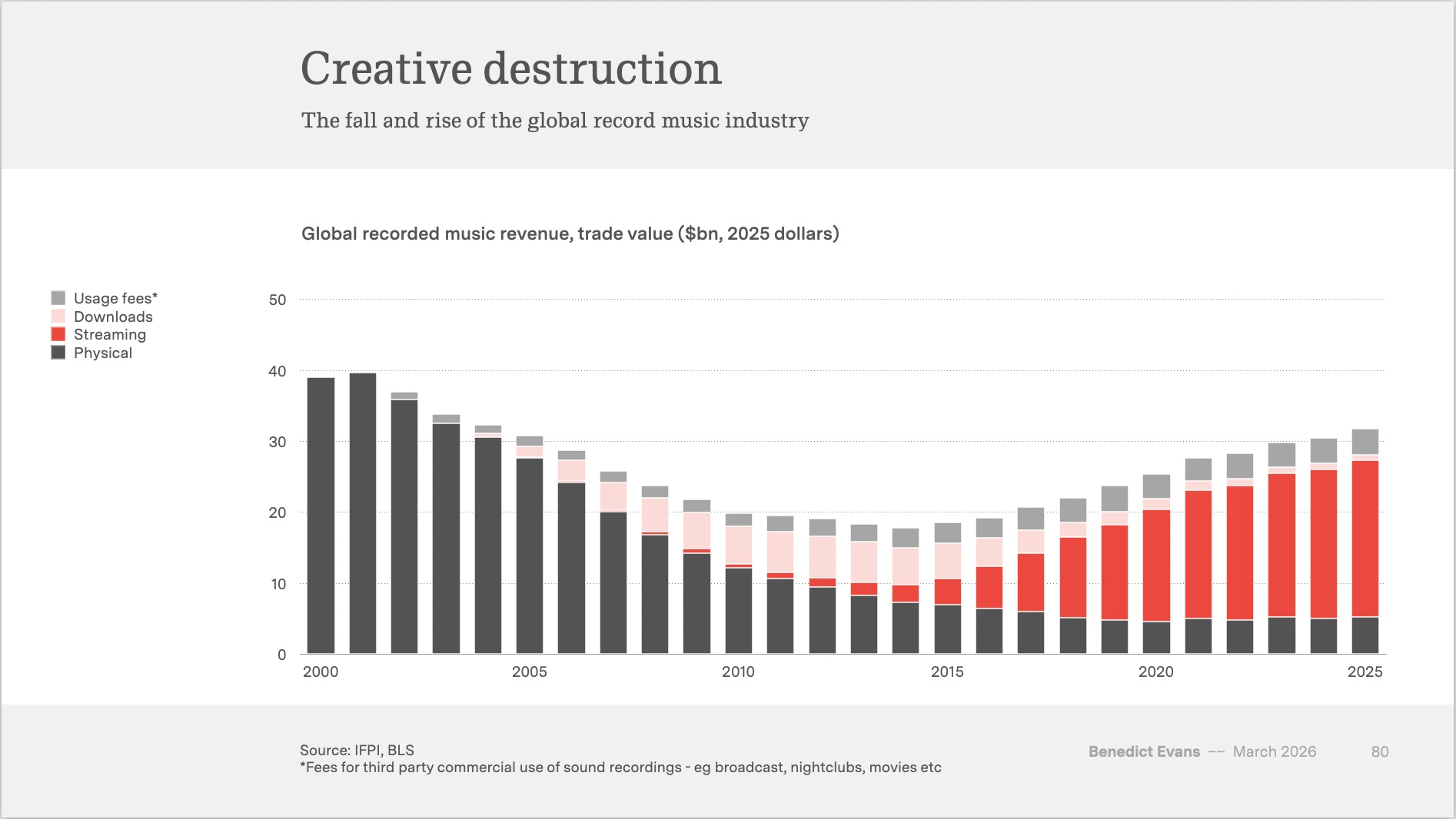
It’s almost as if we humans, with these funny hands and fingers of ours, actually like to use them.
This matters both for creators and audiences.
For some creators, the physical process is simply more satisfying. Like the engineer who still wants to learn new coding languages, the guitarist who spends a decade training is choosing the harder path because it offers personal meaning.
The audience side of this argument is equally strong. With streaming platforms flooded by AI content, physical creation is a rarer, more valuable offering. The live show, the physical instrument, the performer’s relationship with their audience—these are scarce in a way a generated audio file can never be. The physical body anchors the work to a specific human and shows us the effort in the creative act.
The New Calculus
This reframes the usual AI-and-creativity debate. The question isn’t whether AI will produce music that sounds good, it increasingly does, and markets have proven audiences are happy consuming algorithmically optimized output, from reality TV to lofi playlists.
The question then is what kind of value survives in a world where the push of a button can create infinite digital files.
When cheap goods flood the bottom layer of a market, people start looking for signals of “specialness” at the top, like labeling a food organic or that a garment is hand-sewn. So while streaming made music ubiquitous, vinyl had a surprising resurgence. And when Instagram made us all digital photographers, sales of physical film cameras surged.
By this logic, some parts of the music economy, like background music, may lean even further into pure utility. At the same time, we may see an increase in the value of the least-automatable components: instruments, venues, and contexts in which a creator has a uniquely human interaction with their audience.
This doesn’t mean music creation or taste becomes worthless. Taste has always mattered and will continue to matter–picking the best 1% and rejecting the 99%. Many of the most successful artists of the next decade will use AI as a creative tool, exploring directions they might never have found alone. The market will still likely reward curation and originality.
But if everyone has access to the same creative tools, then taste alone may not be enough. That’s why the context around that taste–identity, community, and embodiment–becomes even more important.
The economic principle of Baumol’s Cost Disease may have been formulated in the 1960s, but it was as true decades (or centuries!) ago as in the AI era. Anyone can generate a track instantly, but it still takes four people to perform a string quartet (or a rock band or whatever the humans may want to play for us.)
In an era in which any music can be created, we don’t just want to hear the thing, we want to see its creator wrestle with it.
Listen here: Spotify | Apple Podcasts | Overcast
Or you can watch the full video here.